
University of Alaska Student Devours AI Art in Protest After Storming a Gallery
A UAF student took matters into his own hands, and mouth, in protest of AI-generated art.

Published Jan. 20 2026, 1:09 p.m. ET

The use of Artificial Intelligence (AI) is undeniably a controversial topic. People stand on a range of opinions on the issue, from people who truly love AI and incorporate it frequently into their lives, to those who loathe it and refuse to so much as interact, knowingly, with an AI program.
While AI is still relatively in its infancy, it's already an issue influencing policy and lives, from the daily to the global. However, one arena where AI frequently receives criticism is in the world of art.
Art has always been a uniquely human skill, with the notable exception of human interpretations of animal behavior throughout our existence. So, to see AI encroaching into the one arena where humans have been unique is something that frightens and enrages many people, especially artists who worry their hard-earned skills will soon be replaced by "soulless" AI art.
One art student decided to take matters into his own hand, or rather, mouth, and he ate some AI art in protest.
Art student ate AI art in protest of encroaching digitalization and automation.
According to The New York Post, Graham Granger, an undergraduate in the University of Alaska Fairbanks's film and performing arts program, really took it to the next level in protest of AI art.
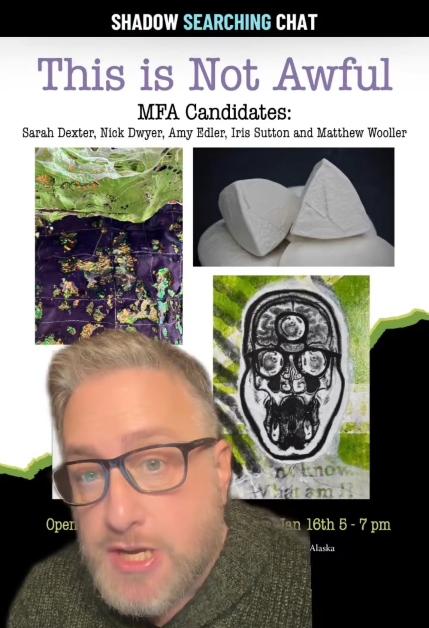
Nick Dwyer, a student in the Master of Fine Arts program at UAF, had displayed a series of 160 polaroid-style prints, using AI to generate them, in the campus's art gallery.
Graham reportedly ripped 57 of the photos down, tore them into pieces, chewed on them, and spit them out. He was eventually arrested and charged with fifth-degree criminal mischief, a Class B misdemeanor under Alaska law.
The destruction of property amounted to around $220.
Ironically, the photos came from Nick's series titled "Shadow Searching: ChatGPT Psychosis." The series was meant to explore "identity and the psychological toll of prolonged interaction with artificial intelligence," per the outlet.
So, while Graham's protest was aimed at the use of AI art, the installation itself was a warning of becoming too cozy with AI.
Other bizarre protests have occurred in art galleries before.
Of course, Graham's bizarre form of protest is a time-honored tradition when it comes to many hot-button topics. Enter: climate crisis protestors and the history of using art to prove a point about a dire topic.
2022 was a particularly hot year for climate crisis activists to target art, usually from groups such as Just Stop Oil, Extinction Rebellion, Germany’s Letzte Generation, and Italy’s Ultima Generazione.
Artnet News notes that the groups have thrown a variety of substances on art pieces in galleries, usually the most famous, to draw attention to the desperation of their message that the planet is spiraling into a void of climate crisis.
According to a report by the LA Times, activists do it to "draw media attention," knowing that their over-the-top antics will draw attention in a way that pleading or protesting traditionally can't do.
Soup was famously lobbed at Vincent Van Gogh's "Sunflowers," and the protestors have glued themselves to installations in the past.
The effectiveness of their message is debatable, but there's no arguing with the effectiveness of drawing attention to it. And while Graham may have missed the memo on what Nick's installation was about, it's clear that this form of protest has moved into the realm of anti-AI, using shock to highlight the importance of a topic most people try to ignore.