
Meet the Colossal Innovation That Could Save Birds Everywhere
"It’s a major milestone for Colossal and a foundational technology for our de-extinction toolkit."

Published May 19 2026, 9:23 a.m. ET

There's something a little surreal about watching a baby chick break free from an egg that didn't come from a hen. But that's exactly what is happening at Colossal Biosciences, the de-extinction company best known for trying to bring back the woolly mammoth and the dodo.
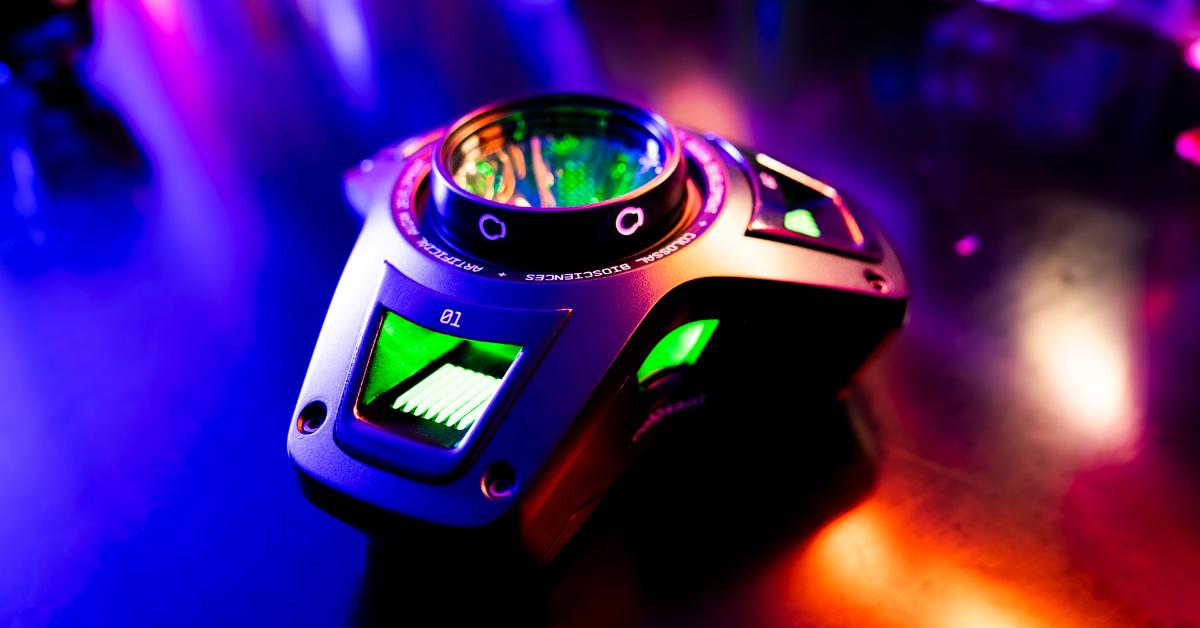
This week, the team announced it has successfully hatched live, healthy chicks from a fully artificial egg — a see-through, lab-built shell that lets a chick grow from microscopic embryo to peeping newborn entirely outside of biology.
If that sounds like science fiction, well, it kind of is. But it's also a quietly beautiful piece of good news for the planet.
Here's why it matters. Birds are in trouble. More than half of the world's bird species are in decline, one in eight is threatened with extinction, and North America alone has lost nearly three billion birds since 1970. Many of the most endangered species are notoriously hard to breed in captivity, and conservationists often have frozen genetic material from rare birds with no way to actually grow a chick from it. Until now.
Colossal's artificial egg — a delicate 3D-printed lattice wrapped in a custom silicone membrane that breathes just like a real shell — gives those efforts a fighting chance. Earlier shell-less experiments in the 1980s required pumping in pure oxygen, which damaged the chicks' DNA. Colossal's version works in regular room air, slips into standard commercial incubators, and can be scaled up to fit a bird of practically any size.
That last part is the secret sauce. The company is using the technology to chase one of its most ambitious projects yet: bringing back the South Island Giant Moa, the towering flightless bird that once roamed New Zealand. Moa eggs were roughly 80 times the volume of a chicken egg. No bird alive today is big enough to act as a surrogate mom. So Colossal is building one out of polymer.
“Every new scalable system for de-extinction is ultimately a biology problem wrapped in an engineering problem. The artificial egg is a perfect example, said Ben Lamm, CEO and Co-Founder at Colossal Biosciences. “Restoring species like the South Island Giant Moa isn’t just about reconstructing ancient genomes and editing PGCs — it requires building an entirely new incubation system where no surrogate exists and scales in ways that ordinary biology simply doesn’t.
"At Colossal, we didn’t just replicate the egg; we re-engineered it from first principles to create something more scalable and controllable. This is what multidisciplinary science makes possible — bringing together biology, materials science, and engineering to solve one of nature’s most elegant systems. It’s a major milestone for Colossal and a foundational technology for our de-extinction toolkit.”
Beyond moa dreams, the implications are huge and very Earth-friendly. Conservationists could rescue compromised embryos that would otherwise die. Scientists could use banked genetic material from species teetering on the brink. Researchers can finally watch embryos develop in real time through the transparent shell, making it easier to study disease resistance and genetic rescue.
It's a reminder that some of the wildest-sounding science is also the most hopeful. Biology, materials engineering, and a whole lot of imagination just teamed up to give vulnerable birds a brand-new shot at survival. And the chicks, by all accounts, are doing just fine.