
What Medicine Left Behind: The Forgotten Science Super Patch Brought Back
Super Patch crossed $200 million in annual revenue in 2025.

Published May 29 2026, 2:51 p.m. ET

For most of human history, healers worked with their hands. Then somewhere along the way, medicine made a decision. It was decided that the most powerful way to help the human body was through chemistry. A pill for the pain, a drug for sleep, a prescription for the fog, and for a long time, that felt like progress.
That knowledge did not disappear. It just got quietly set aside as chemistry took center stage. Researchers moved on, funding followed, and the idea that the skin could be a serious tool for healing got filed away somewhere between folklore and fringe science. That is where things stayed for decades. Until people who were not part of that world started asking the questions that the medical establishment had stopped asking.
Jay Dhaliwal was one of them. A software engineer who thought in systems and signals long before he ever thought about health. In 1983, his mother was diagnosed with Multiple Sclerosis. Within two years, the woman he describes as vibrant and unstoppable was nearly fully disabled. Jay watched the medical system do what it was designed to do: manage her symptoms, adjust her medications, repeat the cycle. But nothing gave her back to herself. That gap, between what medicine could offer and what his mother actually needed, became the question he spent the next 15 years trying to answer.
These personal circumstances pushed him toward one of medicine's oldest and hardest questions, what actually drives healing in the body; he ended up somewhere that felt less like invention and more like rediscovery.
What he found already had a name in research circles. The skin is one of the most densely connected sensory surfaces the human body has. It is in constant communication with the brain, sending and receiving information every second of the day. Most of us just never think about it that way.The best everyday example of this is Braille. Braille works because tiny raised dots pressed against the fingertips can carry meaning all the way to the brain. The skin reads it, and the brain understands it. No sound, no visuals, no chemistry involved.
Just a physical pattern and a nervous system doing exactly what it was built to do. Jay's technology, called Vibrotactile Trigger Technology or VTT, works on that same basic principle. A patch worn on the skin carries a precise, microscopic pattern. That pattern sends a signal. The brain receives it, and the body, which already knows how to regulate sleep and manage discomfort and sharpen focus, starts doing those things more clearly.
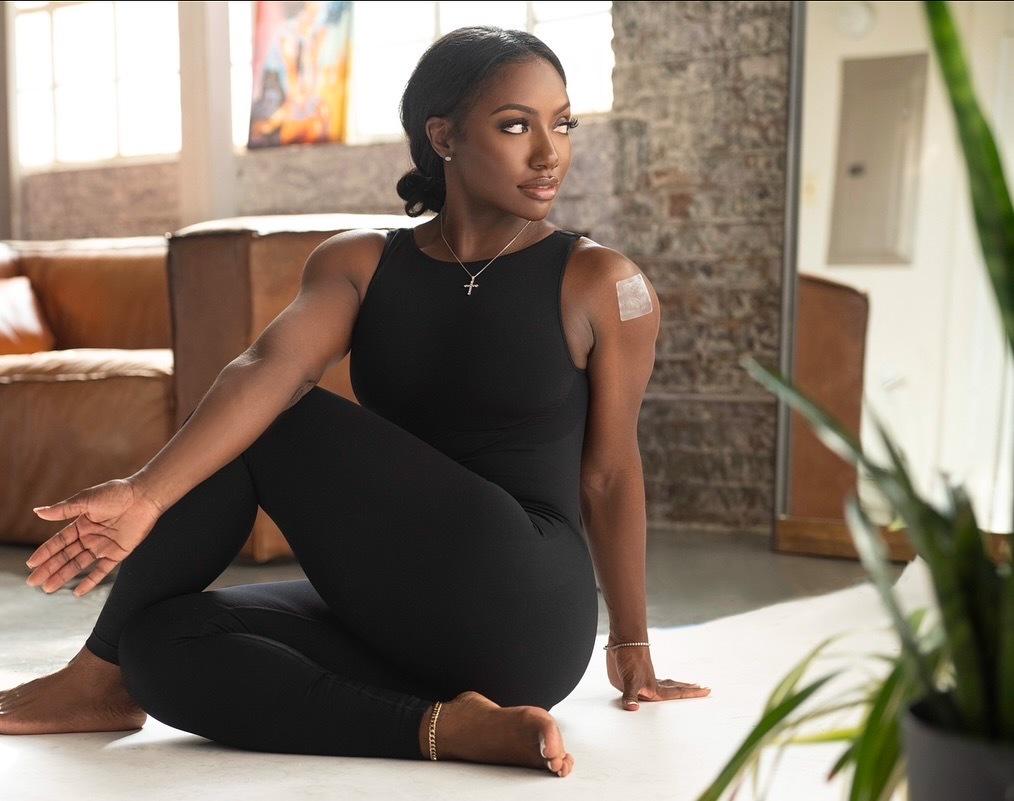
The way Jay explains it is straightforward. The brain and the body are always talking to each other. That conversation can get noisy over time. Stress, age, injury, the general weight of daily life, all of it can make the signals harder to get through. VTT does not add anything foreign to that conversation, it just helps clear up the line.Now, it is fair to ask why this sounds so unfamiliar if the underlying science is not new.
The honest answer is that for most of the last century, the medical world was not looking in this direction. The money, the research, the careers, they were all built around chemistry. Finding a molecule that could force a particular outcome in the body was the game everyone was playing. A patch that simply sends a signal to help the body do something it already knows how to do does not fit neatly into that model.
That is partly why Super Patch spent years being dismissed as too simple. A sticker that helps your brain? It sounds more like a novelty than a solution. But Jay kept going back to science, to build a foundation that could not be easily ignored. Today, Super Patch is backed by 16 peer-reviewed clinical studies.
Six of those are listed on PubMed, which is the same database used by hospitals and medical schools to archive serious research. Studies were conducted at institutions including the University of Arizona. The statistical results came back at a confidence level of 0.001. To put that in plain terms, the standard threshold for "this result is real" in medical research is 0.05. Super Patch's results are fifty times more certain than that bar requires.
The adoption that followed tells its own story. Thousands of physicians across the United States now recommend Super Patch to their patients. More than 12 NFL teams use it. So do athletes across the NBA, NHL, and MLB. These are environments where results are everything and skepticism is the default. Nobody in a professional locker room uses something because it sounds interesting; they use it because it works.
And then there is the number that is genuinely hard to explain away. Super Patch crossed $200 million in annual revenue in 2025. No outside investment, no venture capital, no large advertising budget. That kind of growth, in any industry, means one thing: people are telling other people, millions of them.
That is actually how most trusted things spread, quietly, through personal experience, one conversation at a time. What makes Super Patch worth paying attention to is not just what the technology does. It is what it represents. A whole branch of science that medicine walked away from, the idea that physical signals on the skin can meaningfully communicate with the brain, turns out to have been worth following all along.
The pharmaceutical model is not going anywhere. Drugs save lives and that is not up for debate, but there has always been a gap between what chemistry can do and what people actually need on a daily basis. The tired parent who cannot sleep, the aging grandparent whose joints make mornings hard, the office worker who gets to 3pm and feels like someone turned the lights down inside their head.
For all of those people, a pill feels like too much, and doing nothing feels like giving up. Super Patch sits in that space. Not as a replacement for medicine, but as something medicine mostly forgot to keep developing.
Touch was the first language the body ever learned; it turns out it still has a lot to say.