
Therapist Shares the "One Thing Boomer Parents Always Do" That Traumatizes Their Children
"These are adult children now."

Updated Dec. 10 2025, 2:11 p.m. ET
It may be a terrifying prospect, but we all need to accept that people born in 2000 are now fully functioning adults. Millennials and Gen X are facing plenty of obstacles in life, whether it's ballooning house prices, rampant inflation, or global warming.
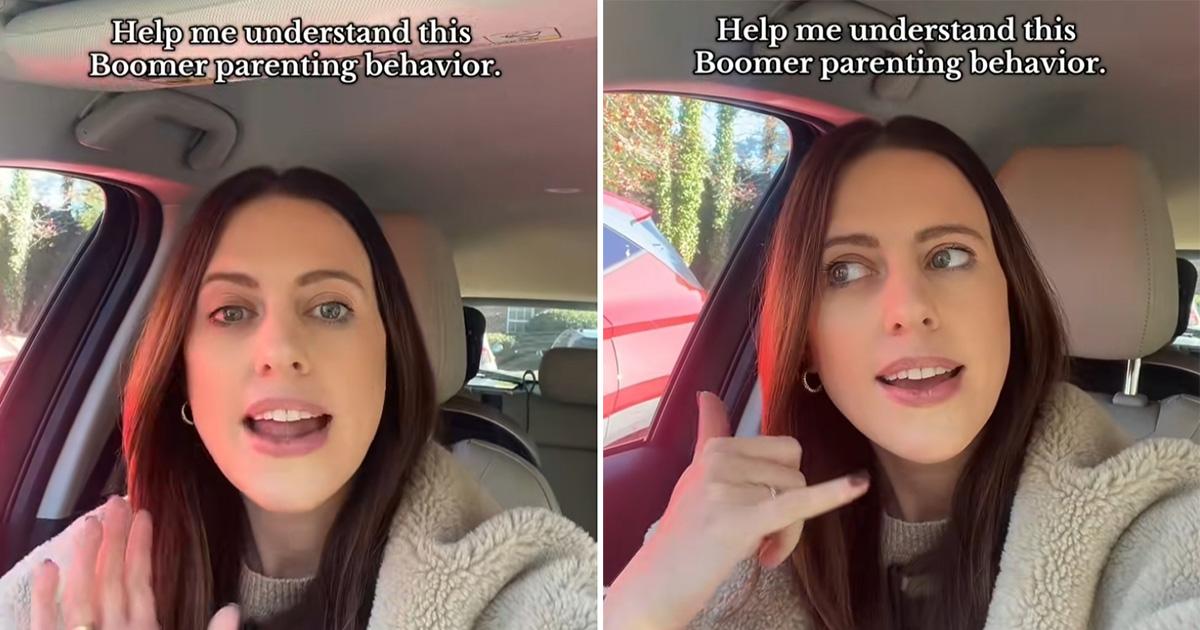
And according to one family therapist, they're also facing challenges from their Boomer parents. Mary Beth, a family therapist with 10 years of experience, recently took to TikTok to share the one thing that boomer parents consistently do that's hard to understand.
"I truly do not understand," Mary Beth explains. "And I really would like to understand this, because I do think it would really help my Gen X and millennial adult clients."
"I'm gonna play the part of the boomer parent," Beth adds, as they give some examples they've heard from clients.
Playing the part of a boomer talking to their child over the phone, Mary Beth says, "Hey, honey. Yeah. Oh, I hope you're having a good day. Yeah. I just wanna let you know your dad had surgery today. Yeah? Yeah, it's, uh. Well, it was, um. It was open-heart surgery. Uh. Hmm. Yeah. Oh. Oh, don't. We just didn't wanna worry you. Yeah, we didn't. We didn't wanna worry you. Yeah."
Another example Mary Beth gives involves grandma: "Hey, honey. How you doing? Yep. Well, Grandma's. Grandma's been on life support for the last week, and it's not looking good, so, you know, we thought we'd let you know. Yeah. Yeah, well, we wanted to wait until we knew. We knew for sure that it wasn't looking good till we called."
Essentially, Mary Beth consistently hears from clients that boomer parents tend to leave sharing important family news until the very last second.
Mary Beth adds: "I understand protecting your children from information that may not be, like, developmentally appropriate when it comes to illness with family members, whatever. But these are adult children now. These are adults, and they can make their own decisions."
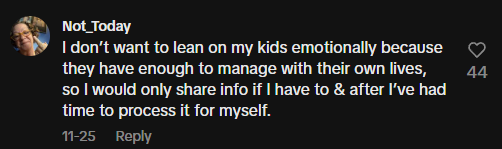
Explaining how this makes clients feel, Mary Beth adds: "They come in my office, and they're like, 'I'm angry', 'I'm sad'. 'I feel betrayed. I feel like I can't trust my parents to share really important health information about immediate family members with me.'"
"I don't understand this," Mary Beth continues.
"If the idea here was to spare your adult child some anxiety, it has backfired. The lack of communication regarding important family health events has not only increased their anxiety now because they don't trust that you'll tell them, but it's resulted in a fracture in your relationship or a breach of trust."

Even when clients tell their parents they'd like clearer communication, Mary Beth says that often doesn't happen: "And then even when the adult child communicates that this is not the type of communication that they want withheld, it usually continues out over again in the future."
Mary Beth concludes: "It doesn't make a lot of sense to me, and it's upsetting a lot of my clients. And we must be missing something, either culturally or generationally, and I'd really like to understand it."
People from pretty much every generation took to the comments section to share their opinion.
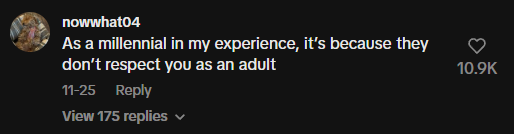
One parent wrote: "I don’t want to lean on my kids emotionally because they have enough to manage with their own lives, so I would only share info if I have to & after I’ve had time to process it for myself."
One commenter suggested: "I think it truly is the fact that they were taught to keep things private and not worry their kids. Simple as that."

While one millennial added: "As a millennial in my experience, it’s because they don’t respect you as an adult."
Another summarized: "They seem to be downplaying things because they’re so uncomfortable with emotions."