
What Does “Touch Money” Mean in Basketball? Plus, Why Fans Turned on Kentucky
A chant meant to project confidence backfired fast. “Touch money” ignited fan outrage after Kentucky’s blowout loss.
Published Jan. 29 2026, 11:21 a.m. ET

Kentucky Loses to Vanderbilt after chanting "touch money" before the game
College basketball rivalries thrive on bravado, but sometimes confidence lands the wrong way. That’s what happened when a chant rang out before a Kentucky game and instantly shifted the mood around the program. What sounded like swagger to some came off as inappropriate to others, especially once the final score hit the board.
As clips circulated, fans asked the same question. What does "touch money" mean in basketball, and why did it spark such a strong reaction?
The phrase itself wasn’t new, but the moment it was used, and what followed, turned it into a flashpoint for long-standing frustrations. Here's why everyone is in an uproar.
What does “touch money” mean in basketball and everyday slang?
“Touch money” is not specific to basketball and was not created by Kentucky players or fans.
According to Urban Dictionary, touch money is "used when parting ways, in place of goodbye. It indicates that you should always keep money close at hand, or it can serve as a reminder to always stay on that paper chase." The term was added to Urban Dictionary in 2021.
When fans heard it chanted by Kentucky before the game, many interpreted it as a celebration of money rather than on-court performance.
In the current college basketball climate, where NIL (Name, Image, Likeness) money has already reshaped rosters and recruiting, many fans are sensitive to anything that suggests money is driving decisions more than team chemistry or development.
The phrase may have been intended as bravado, but its meaning outside basketball shaped how it was received.
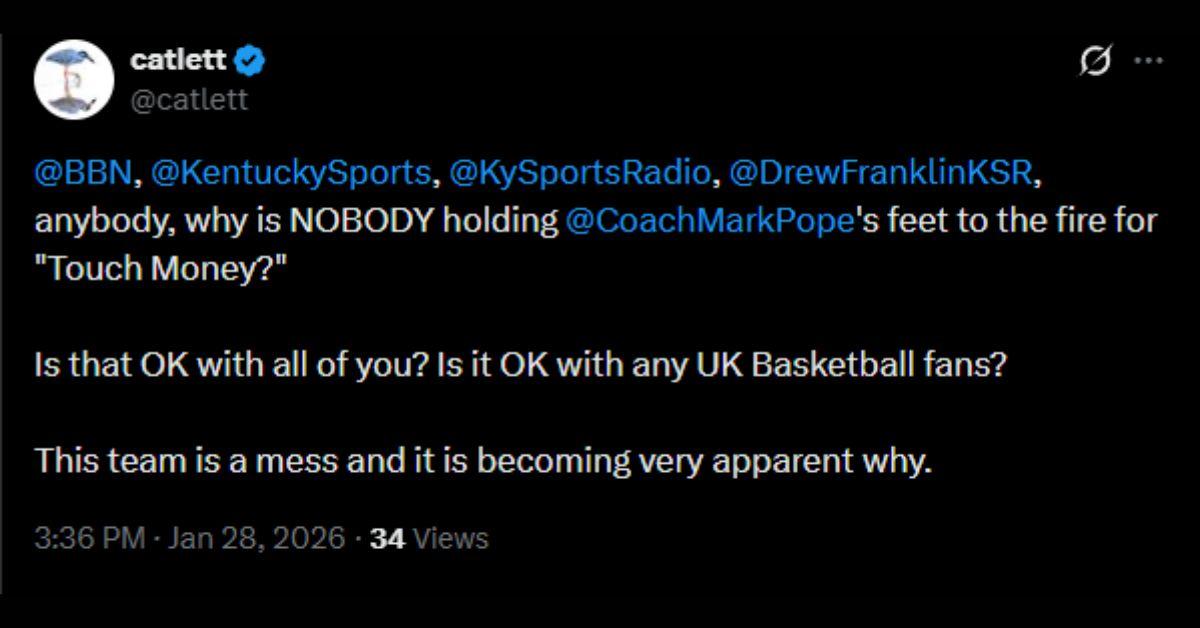
Online reaction turned sharply negative. Some fans questioned whether the focus on high-profile scorers and NIL expectations had replaced roster building.
One fan wrote on X, "Regardless of the intention of what is being said and done in this video (I can’t know what is running through their heads), they should know that right now, no fan or supporter of their team wants to see this. It’s a bad look."
Another wrote "More Kentucky's to come, the system is shattered. A sad state."
Here's why fans were upset and what it says about Kentucky’s program.
The backlash intensified after the result. The Kentucky Wildcats lost 80–55 to the Vanderbilt Commodores, a 25-point defeat that undercut any message of confidence.
That loss didn’t exist in isolation. While Kentucky had won five straight games before Vanderbilt, earlier losses to Michigan State, North Carolina, Gonzaga, Alabama, and Missouri had already strained patience.
For many sports fans, the chant became a shorthand for deeper concerns. Some asked whether the program had drifted away from what they loved about the game. Others wondered if inconsistency and unmet expectations had finally reached a breaking point.
The timing made it worse. When confidence isn’t backed by results, it reads differently.
“Touch money” didn’t derail Kentucky’s season on its own, but it crystallized a moment fans were already uneasy about. The phrase wasn’t invented in the arena, yet chanting it before a lopsided loss made it feel like the wrong message at the wrong time. In college basketball, perception matters, and for many fans, this moment wasn’t about slang. It was about whether the program still reflects what they believe it should be.