
Here's Who Built the Artemis 2 Crew's Space Launch System Rocket
The astronauts return from their 10-day journey around the moon on April 10, 2026.
Published April 10 2026, 12:08 p.m. ET

NASA launched the Artemis 2 Crew's 10-day mission around the moon on April 1, 2026, and people are curious who built the Space Launch System rocket. Astronauts Reid Wiseman, Victor Glover, Christina Koch, and Jeremy Hansen were aboard the spaceship when it launched on its historic mission, which is the first human mission around the Moon since Apollo 17.
The Artemis 2 is set to reenter Earth's atmosphere on April 10, which is reportedly the most dangerous part of the space mission, per CNN. The rocket will travel more than 30 times the speed of sound as it reenters the atmosphere, causing intense compression of air molecules that are heating the spaceship's exterior to 5,000 degrees Fahrenheit. The danger has folks wondering who built the spacecraft.
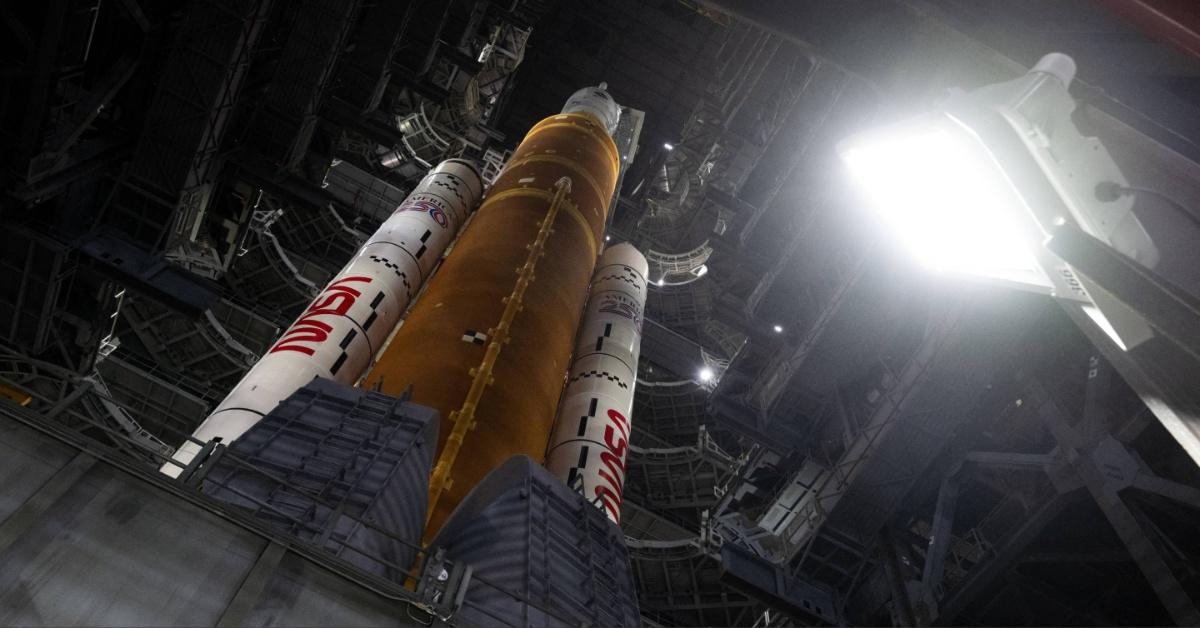
Who built the Artemis 2 crew's Space Launch System rocket?
Several companies helped to build the Space Launch System (SLS) rocket. The prime contractor for the NASA Orion spacecraft used on the Artemis 2 mission is defense and aerospace manufacturer Lockheed Martin in El Segundo, Calif. The company designed and built the spaceship. per California Governor Gavin Newsom.
The French company Airbus built the ESM-2 system in the craft that powers the ship and supplies the astronauts with thermal control, air, and water during the mission.
Northrop Grumman is another California-based company that provided the airdraft with twin solid rocket boosters that assist in powering the SLS and key propulsion for Orion’s launch abort system. Precision Aerospace provided the RS-25 engine components, and Precision Tube Bending made the custom tubing for the SLS core stage systems and RS-25 engines. Parts for the rocket's engine were made by the Sacramento company, Tecma, and SpaceX in Hawthorne developed the human landing system.
VACCO Industries in El Monte made the pre-valves and advanced cryogenic fluid control systems for SLS propellant tanks, while Votaw Precision Technologies in Santa Fe Springs provided the metal parts for the SLS flight hardware.
L3Harris Technologies company Aerojet Rocketdyne in Canoga Park made the engines for the SLS rocket, and AMRO Karman Space and Defense in South El Monte made the machining and welding for the rocket's components. Beranek, LLC Precision Machining in Torrance also provided critical components, and Boeing Los Angeles County made the SLS core stage.
Kirkhill, Inc. in Santa Fe Springs provided the erosion-resistant insulation needed to protect hardware from weather and extreme temperatures during the rocket's launch and flight, while LeFiell Manufacturing Company in Brea supplied the miles of metallic tubing needed for the SLS Block 1 rocket.
Despite reentry being the most dangerous part of the mission, pilot Victor Glover said it was the part he was most excited about.
When asked what part of the mission he looked forward to the most, he said, “One of the first press conferences, we were asked, 'What are we looking forward to?' And I said, 'splashdown.' And it’s kind of humorous, but it’s literal as well — that we have to get back. There’s so much data that you’ve seen already, but all the good stuff is coming back with us. There’s so many more pictures, so many more stories."