
Donald Trump’s Artemis II Call Turns Awkward After Silence With Astronauts
A routine NASA call with Trump took an unexpected turn when awkward silence lingered a bit too long.
Published April 8 2026, 10:41 a.m. ET

After Artemis II wrapped its historic space mission on April 6, Donald Trump joined NASA’s live coverage for a call with commander Reid Wiseman, pilot Victor Glover, and mission specialists Christina Koch and Jeremy Hansen.
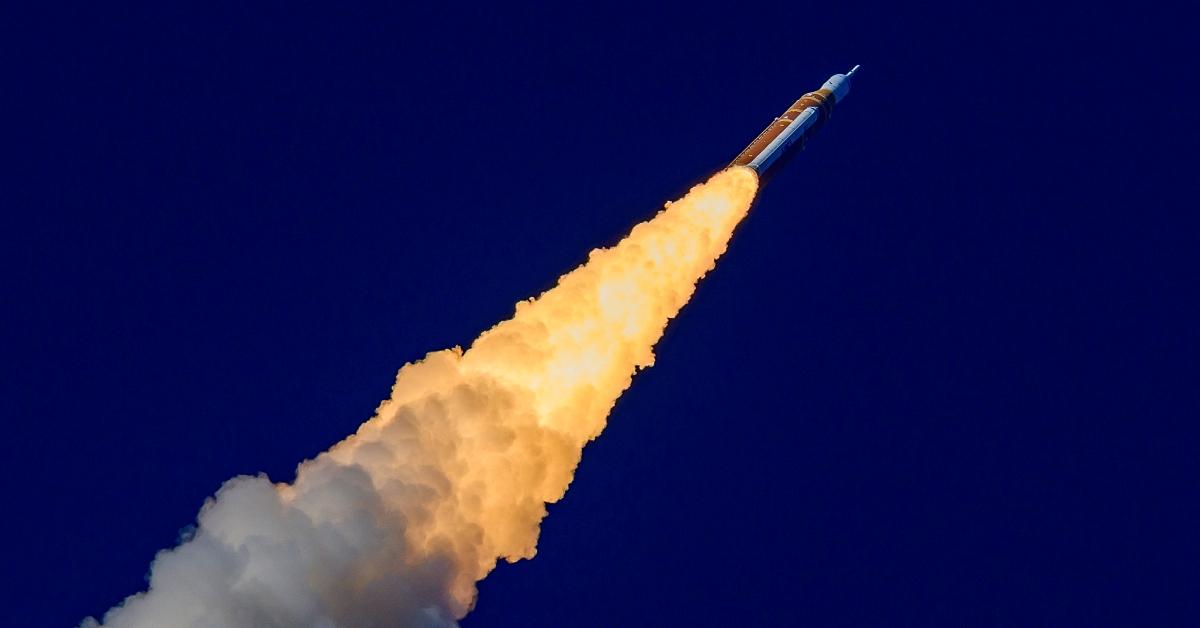
Artemis II launched from Kennedy Space Center on April 1 as the first crewed Artemis flight and the first human mission around the Moon since Apollo 17, with an approximately 10-day trip around the Moon and back. However, netizens are now zeroing in on an awkward moment during Trump’s call that left the room completely silent.

What caused Trump’s awkward moment with the Artemis astronauts?
The crew is using Orion to test how the spacecraft performs in deep space. They are evaluating life-support systems, propulsion, navigation, manual operations, communications at lunar distances, and reentry procedures. NASA also has astronauts conducting lunar observations and human-health science. By April 7, the crew had already started heading home. They spoke with the International Space Station crew, debriefed lunar science teams, and completed their first return correction burn.
Trump opened the call by congratulating the crew after they broke the record for the farthest humans have ever traveled from Earth, according to Newsweek. He told them they had “made history and made all America really proud.” During the conversation, he also praised their courage, singled out Hansen as a Canadian crew member, referenced conversations with Wayne Gretzky and Prime Minister Mark Carney, and invited the astronauts to visit the White House after they get back.
Then came the part everybody noticed. After Trump finished a stretch of remarks, the line sat quiet for roughly a minute. Reid eventually asked for “a quick comms check,” and Trump answered, “I am, yes.”
Trump later blamed the pause on a “nine-second delay” and said, “It is a long distance.”
What was the Artemis II mission?
Even with that awkward pause, the mission itself remained the bigger story. The crew completed a seven-hour lunar observation period. They passed behind the Moon during a planned communications blackout. They also set a new distance record of about 252,756 miles from Earth. The astronauts captured images of the lunar far side, Earthset, and a solar eclipse. Christina later told Space.com that seeing Earth again after the far side blackout was one of the mission’s biggest highlights.
"I think one of the biggest highlights was coming back from the far side of the moon and having the first glimpse of the planet Earth again after being out of communication for about 45 minutes," Christina said. "It really just reminds you what a special place we have and how important it is for our nation to lead and not follow in exploring deep space."
If the schedule holds, Artemis II will be complete when Orion splashes down off the coast of San Diego at about 8:07 p.m. EDT, or 5:07 p.m. PDT, on Friday, April 10. Recovery teams are set to move the astronauts to the USS John P. Murtha before they head back to Houston. After that, NASA’s next step is Artemis III in 2027, which is currently planned as a low-Earth-orbit rendezvous-and-docking test with commercial landers.