
Wikipedia Always Seems to be Asking for Money — Why Is That?
Wikipedia is a one-stop-shop for getting your research underway, providing links to reputable sites.

Published Dec. 8 2025, 4:26 p.m. ET

When you open a search engine, you're likely to use one of the big ones, such as Google. And when you search up a query, there's a good chance that, regardless of which search engine you use, you're going to see Wikipedia among some of the top results.
The ever-present site has been around since 2001, making it one of the foundational corners of the internet. But you might be surprised to navigate to the website and see them soliciting a donation. So, why is Wikipedia, one of the most famous websites in human history, asking for money? Here's what we know.
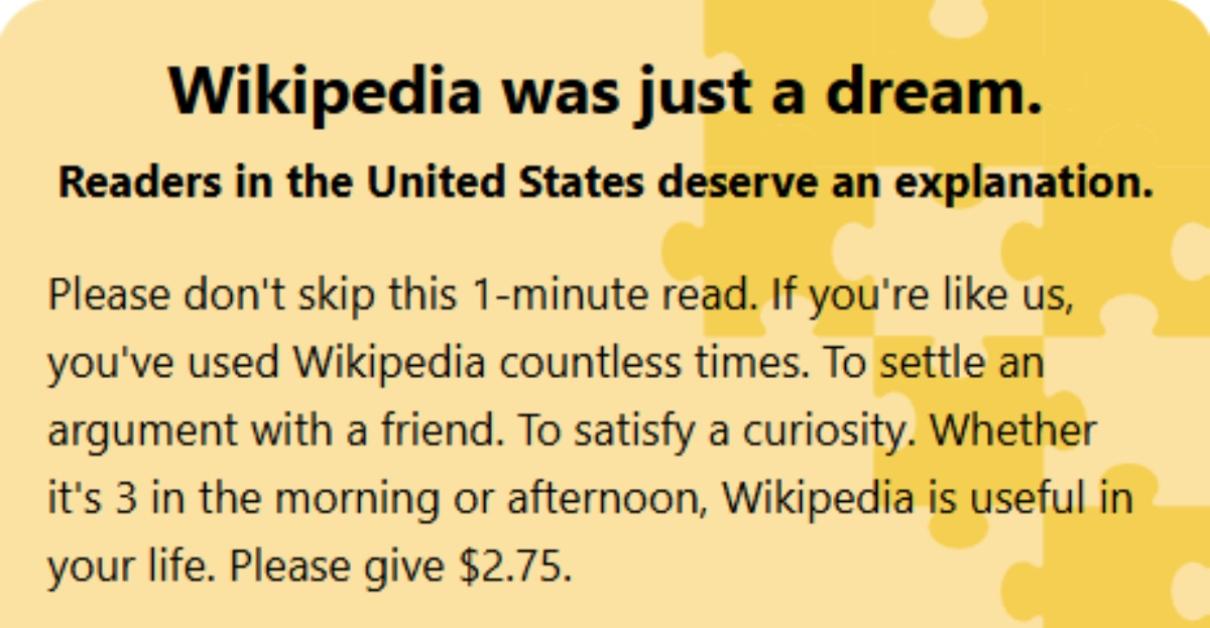
Why is Wikipedia asking for money?
Most websites are run by corporations that fund their creation and upkeep. Costs can be astronomical, especially if the site requires a significant amount of storage, such as Wikipedia. But for the size of the site and the amount of traffic it gets, one must assume that the site supports itself, right? Apparently, wrong.
According to Business Standard, Wikipedia consistently ranks among the top 10 most visited websites. But unlike others on the list, including Facebook, Google, and others, Wikipedia is a non-profit. And, according to Business Standard, Wikipedia’s contributors, making an impressive nearly 345 edits per minute on the site, are not paid.
Wikimedia, the foundation behind the website, explains that it receives funding through a variety of sources, including endowments, major gifts, Wikimedia Enterprise, and, you guessed it: donations. So, if you enjoy the neutral and unbiased archive that Wikipedia produces, you might want to toss a few dollars its way.
How does Wikipedia work?
But how exactly does Wikipedia work? We've all navigated to the site before, and not only does the information seem to update to the minute, but people link to ample sources to provide proof for the topics on each page, which makes it a great starting point for research.
The Wikipedia YouTube page explains that the site is a free encyclopedia that's available to anyone to edit. Every month, around 300,000 volunteers edit and update pages, compiling information that requires sources. People who want to update information have to, essentially, provide receipts for the facts that they're adding to the site. It's not considered a primary source for research, but it's a helpful place to find those sources and get an idea for any number of topics.
Wikipedia also explains that articles on Wikipedia are read more than 16 billion times a month. This means that its storage capacity is extraordinary and probably makes up a significant portion of the organization's operating costs.
So, if it doesn't make sense to you that Wikipedia can be so ever-present and massive, yet needs donations, it's because the company itself requires a good bit of storage, and therefore money, to run.
While Wikipedia isn't the be-all, end-all of expertise, the fact that it compiles information on nearly every topic into an easy-to-click and easy-to-source format makes it valuable to the public.