
Here's Why There's Controversy Over Haiti's Olympic Uniforms
The teams 2026 Olympic uniforms were created by designer Stella Jean.
Published Feb. 10 2026, 1:09 p.m. ET

The XXV Winter Olympic Games are underway in Milan and Cortina, Italy, and everyone is talking about team Haiti. The country only has two athletes competing in the 2026 Olympics — Richardson Viano is an alpine skier, and Stevenson Savart is competing in cross-country skiing, per the Olympics. However, it's their uniforms that are grabbing all the attention. Haiti's uniforms were designed by Haitian-Italian designer Stella Jean, who also created Haiti's uniforms for the 2024 Paris Summer Olympics.
For the Opening Ceremony in Italy, female delegation members from Haiti wore puffer skirts with traditional Haitian tignon headwraps, and for the skier's uniforms, Stella used a painting from Miami-based Haitian artist Edouard Duval-Carrié. The painting depicts revolutionary Toussaint Louverture on horseback, charging into battle. The unitforms are now part of the Olympic Museum’s collection, so what was the issue?
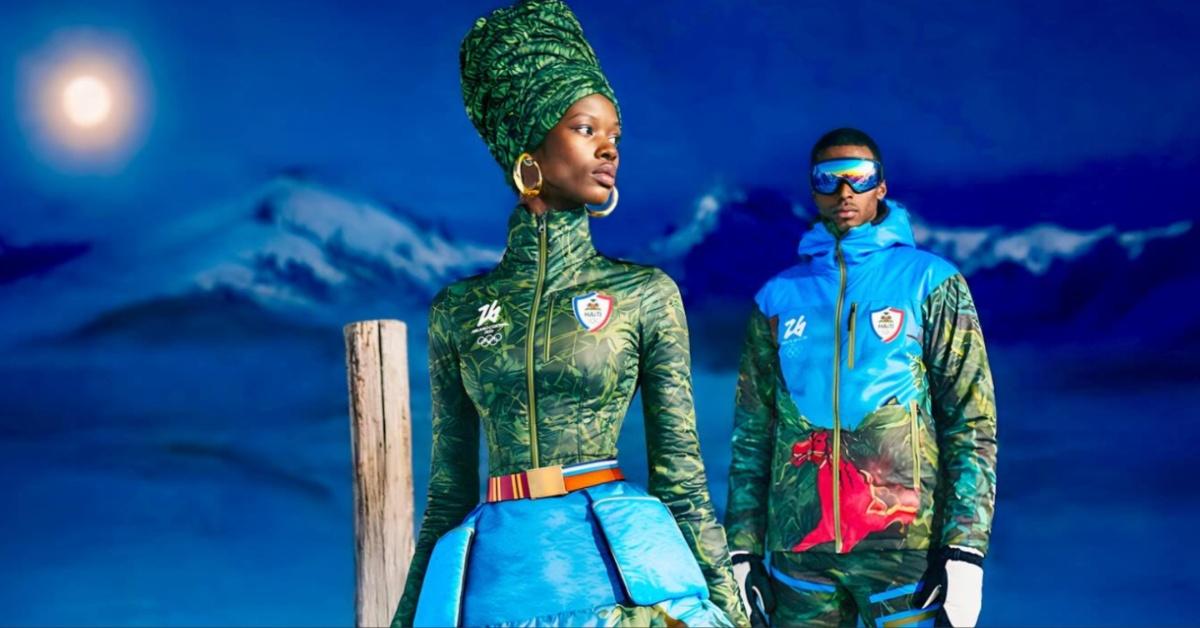
Here's why there's controversy over Haiti's Olympic uniforms.
Haiti's Olympic uniforms included a red horse and a sword that turned into a snake in Toussaint’s hand. The snake symbolizes the great spirit of wisdom, peace, and purity, Danbala. The painting was created more than two decades ago, and Stella spent a year working on the uniforms, according to the Miami Herald.
However, Stella was told in January that the image of Toussaint violated the International Olympic Committee rules that prohibit political, religious, or racial propaganda on Olympic uniforms.
Stella was forced to change the uniforms without a budget and without much time.
"For 24 hours, I said, ‘It’s over. They won’t have any uniform.' But then I also thought that what brought us here was Haitian art, Haitian culture, Haitian excellence. So many human factors that helped us to be there."
The designer then got help from Italian artisans to recreate and hand-paint the Olympic uniforms.
“Five days ago, they started to hand-paint all the uniforms, and yesterday night, I brought them myself in Milan from the other regions,” said Stella.
Toussaint's image was removed from the Olympic uniforms, but the red horse remains. The word “Haiti” was also added on the back of the uniforms set against a blue sky.
Stella said that every piece of Haiti's Olympic uniforms "has a specific historical meaning for it." The uniforms for the rest of the delegation include a head wrap that was inspired by the tignon. French colonizers forced enslaved Black women to cover their hair with tignons because the men's wives were jealous of the women being raped by their husbands. Tignons became a fashion statement later on. Stella also created the puffer skirts with pockets to honor Haiti’s street market vendors.
Stella also noted that Haiti's delegation would only be getting about 10 seconds of attention during the Opening Ceremony due to its size.
"We will have just 10 seconds, maybe nine, in which these two athletes will become with their bodies the Haitian flag. We have to say everything without words, just with images, to the world," she said. "The one thing Haiti can always export is our art, our culture, and our creativity.”