
The Kennedy Center Was Designed by a Man Who Believed Permanence Could Be Powerful
President John F. Kennedy wanted all citizens to have access to the arts.

Updated Feb. 2 2026, 4:26 p.m. ET

The John F. Kennedy Center for the Performing Arts was initially called the National Cultural Center. In 1958, President Dwight D. Eisenhower signed into law the National Cultural Center Act, which authorized the construction of a national performing arts center in Washington, D.C., under the Smithsonian Institution. After President John F. Kennedy was assassinated in November 1963, President Lyndon B. Johnson signed into law legislation renaming the venue.
The groundbreaking ceremony was held in December 1964, where Johnson quoted Kennedy. "I look forward to an America which will steadily raise the standards of artistic accomplishment and which will steadily enlarge cultural opportunities for all of our citizens," said the late president. Lyndon said that they were taking a very important step towards Kennedy's dream. The architect hired to design the Kennedy Center was tasked with designing a symbol of hope. Here's what we know.
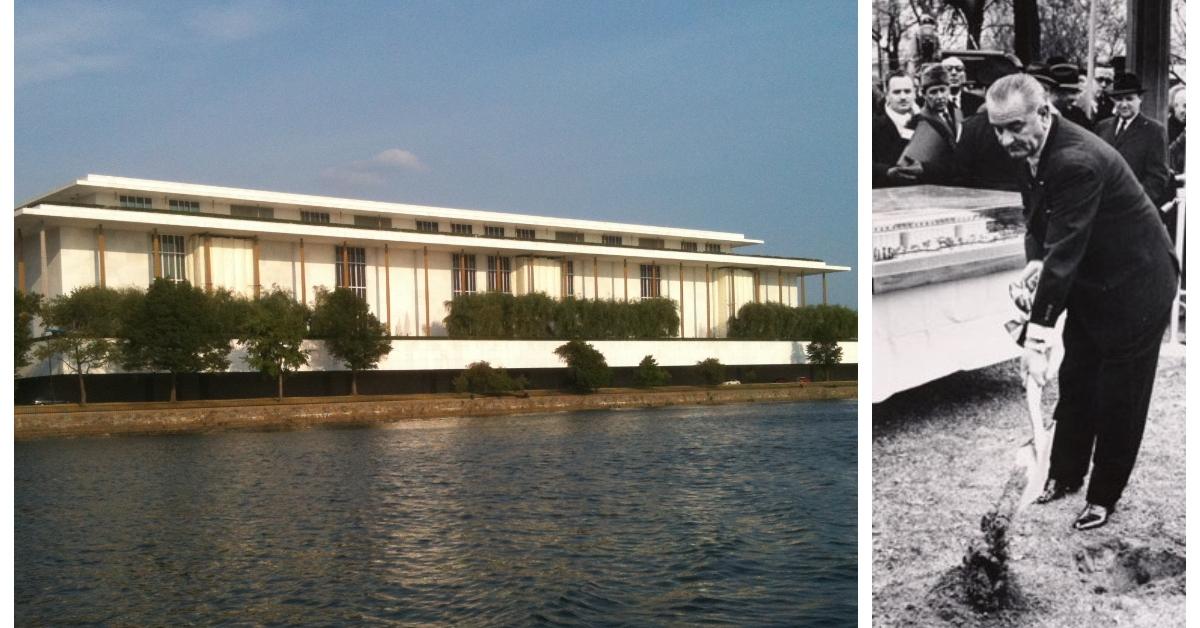
The architect who designed the Kennedy Center had gone though a major change in his work.
The Kennedy Center was designed by Edward Durell Stone, who died April 6, 1978, at the age of 76, per The New York Times. More than a decade before construction began, Stone had completely changed his design preferences. He moved away from a more severe International Style in favor of a more flashy personal style.
This new approach was fully realized in 1954 when Stone's designs for the United States Embassy in New Delhi made their debut. People were drawn to the ornate concrete grille and fountains that dotted the outside. The decorative grille would become a signature look for Stone, whose work on this project led to the Kennedy Center. In fact, the Embassy and the Kennedy Center look quite similar.
Stone was reluctant to label his style, but if pressed to choose, he called it "romanticist." He shied away from the impermanence of glass and aluminum, which he gravitated towards early in his career. Instead, Stone preferred concrete, brick, and stone, which have more longevity. It doesn't convey a feeling of obsolescence.
When was the Kennedy Center built?
One year after Johnson ceremoniously shoveled the first bit of dirt out from where the Kennedy Center would soon be, the construction of the venue began in December 1965. There were various issues to contend with leading up to this moment. One was the exact location of the Kennedy Center. According to The New York Times, the $65 million facility was either going to be built downtown on Pennsylvania Avenue or closer to the Potomac River. Eventually, the waterfront view was the winner.
All of 1966 was spent digging up the foundation. When it was time to start building, materials were provided by Bethlehem Steel. On Jan. 29, 1968, the steel frame for the Concert Hall was completed, and eight months later, the same frame was constructed for the Eisenhower Theater. Marble used for the interior and exterior were gifts from Italy. When the building was near its finish in 1970 and 1971, Sweden provided 18 Orrefors crystal chandeliers.
In May 1971, the Meyer Davis Orchestra performed at the first public event, which was a gala fundraiser to raise money for the Center’s specially priced ticket program for students, seniors, and patrons with fixed low incomes. At the groundbreaking ceremony, Johnson said he wanted the center to be a "living force for the encouragement of art." For a time, it was.