
Rachel Sacksner Builds Fashion From Memory, Survival, and Meaning
In her collection Tools of Survival, Rachel Sacksner turns family history into garments that carry liberation, resourcefulness, and emotional weight

Published May 5 2026, 10:23 p.m. ET

Rachel Sacksner did not arrive at fashion through surface. She arrived at it through story, inheritance, and a growing conviction that clothes can hold far more than appearance. One of the clearest expressions of that belief is Tools of Survival, the collection that helped define her design perspective.
Rooted in her family history, the work draws on the story of her great-grandmother, a Holocaust survivor whose wedding dress was made from a World War II parachute. For Sacksner, that image was not only moving. It became a foundation.
“That story changed the way I understood design,” Sacksner says. “It showed me that a garment can come out of necessity, hold beauty, and still carry history in a very real way.”
That relationship between material and memory sits at the center of her work. In Tools of Survival, Sacksner repurposed old war parachutes and secondhand objects, including spoons tied to her grandmother’s story, to build physical expressions of survival, liberation, and rebirth. The result was not a collection built around nostalgia. It was a collection built around meaning. Every fabric choice, every reference, and every form had to do more than look compelling. It had to communicate.
“I am interested in design that makes people feel something and think about something,” she says. “I do not want a garment to stop at aesthetics.”
That way of thinking did not appear overnight. Sacksner grew up surrounded by women who were constantly creating. Many of the women in her family were artists, fashion illustrators, and seamstresses, and that environment shaped her early sense of what creativity could be. It was never framed as decoration or as a side interest. It was part of everyday life.
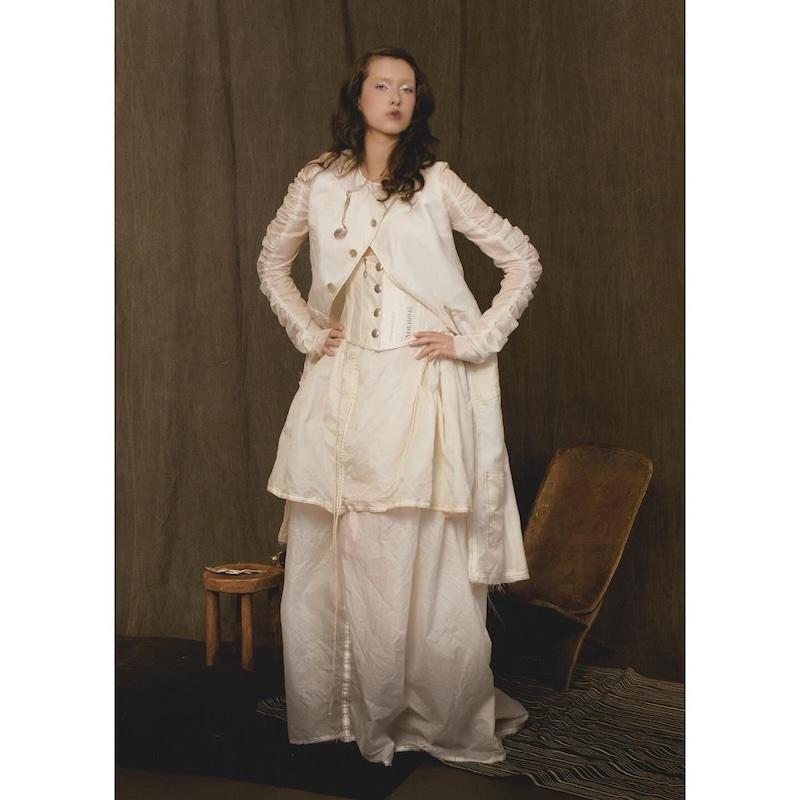
“Being around women who made things all the time gave me a very specific foundation,” Sacksner says. “It taught me that creativity could be a way of life, not just something you admire from a distance.”
As a teenager, she started exploring different avenues of design. She first pursued an education in interior design while continuing to design clothes on the side, an experience that deepened her understanding of how functionality and creativity can work together. That path later led her into a bachelor’s degree in fashion design, where she was able to bring her technical understanding of structure and utility into the field she felt most drawn to.
“Interior design taught me a lot about form, use, and intention,” she says. “Fashion gave me the space to apply those ideas in a way that felt much more personal.”
That blend of technical discipline and emotional narrative is what makes Sacksner’s work feel distinct. She is not simply interested in making clothes that are visually strong. She is interested in making garments that evoke thought, carry purpose, and reflect a clear interior logic. In Tools of Survival, that logic came into focus in a way that changed her understanding of herself as a designer. The collection did not just showcase her aesthetic. It solidified the deeper values behind her practice.
“That collection really built the foundation for how I think,” Sacksner says. “It clarified what I believe fashion can do when it is grounded in education, history, and art.”
It also sharpened her commitment to repurposing and sustainability, not as trend language, but as an extension of the collection’s meaning. Learning more deeply about her family history changed the way she thought about clothing and resourcefulness. The idea that something beautiful and significant could emerge from necessity made her more conscious of material, process, and purpose.
“Once I understood that history more deeply, I could not think about fabric the same way,” she says. “Material stopped being neutral. It became part of the story.”
That level of care has also required Sacksner to trust her own perspective in an industry that often pushes designers toward speed, trends, and sellability. She describes herself as detail oriented and perfectionistic, and says that one of her biggest challenges has been finding the balance between her own values and what the industry often rewards. “It took time to trust that my perspective was enough,” she says. “When you are in a fast moving industry, there is always pressure to look outward. I had to learn how to stay clear on what mattered to me.”
That clarity has come with discipline. Sacksner says one of the biggest lessons she has learned is that intention matters at every stage of the design process. Every decision has to serve a purpose. She has also learned that editing is just as important as creating, and that patience is necessary if the final work is going to feel considered and lasting. “A strong idea is not enough on its own,” she says. “You have to refine it. You have to step back. You have to be willing to let the work take time.”
That philosophy gives her work a depth that feels increasingly important in a fashion landscape that can sometimes reward novelty over substance. Sacksner is interested in building something slower, sharper, and more lasting. She wants each collection to be driven by strong narratives and technical rigor, and she wants her brand to ask more of fashion than beauty alone.
“I want my work to make people think beyond the surface,” she says. “Whether that happens through my own collections or through collaboration, that is the kind of work I want to keep making.”
That vision is what gives Tools of Survival its force. The collection is personal, but it is not closed in on itself. It uses family history to open a larger conversation about adaptation, memory, and the meaning clothes can carry across generations. It reflects a designer who is not interested in separating feeling from construction or history from form. Rachel Sacksner is building a body of work where those things live together. That is what makes her worth watching. She is not just designing garments. She is building a language for what fashion can remember.
For more information about Rachel Sacksner, visit her Instagram.