
Reports Claim ICE Agent Jonathan Ross Suffered From Internal Bleeding — What Is That Exactly?
Physicians don't use the term "internal bleeding."

Published Jan. 15 2026, 12:04 p.m. ET

There are multiple videos from different angles that, when put together, tell the story of what happened to Renee Nicole Good on Jan. 7, 2026. Perhaps the most revealing footage comes from the cell phone of the man who fatally shot her: ICE agent Jonathan Ross. He was recording at the time of the shooting and caught Good's last words. "That's fine, dude. I'm not mad at you," she said, as he circled around the front of her vehicle past the driver's side door.
After Ross fatally shot Good three times in the head, a voice is heard saying, "F--king b---h." While there is no confirmation that Ross said this, it paints a picture of the emotional response to a woman's death. Other footage shows Ross walking away from her car after it crashed. He appears to be unharmed. One week later, CBS News reported that Ross suffered internal bleeding after he was allegedly hit by Good's car. What does that mean exactly? Here's what we know.

What is the meaning behind ICE agent Jonathan Ross's claims he suffered from internal bleeding?
Hours after Good was killed, Homeland Security Secretary Kristi Noem said in a news conference that Ross was taken to the hospital following the incident. He had since been released, which means he left the hospital the same day he allegedly sustained injuries that left him with internal bleeding, per two U.S. officials.
Although details of Ross's alleged injuries have not been made public, the Department of Homeland Security confirmed them to CBS News. U.S. Border Patrol Commander Gregory Bovino also told the outlet that after Ross reportedly received numerous death threats, he was moved to a safe location. "He's recovering from those injuries, and we're thankful that he's recovering," said Bovino.
Questions regarding the exact meaning of internal bleeding were posed online. The @RoguePOTUSStaff X (formerly Twitter) account shared the CBS News story, asking for clarification from "medical Twitter." Dr. Matthew Ostrowitz, a bariatric surgery specialist in Rockville Centre, N.Y., with over 20 years of experience in the medical field, responded with his medical opinion.
Is a bruise technically internal bleeding?
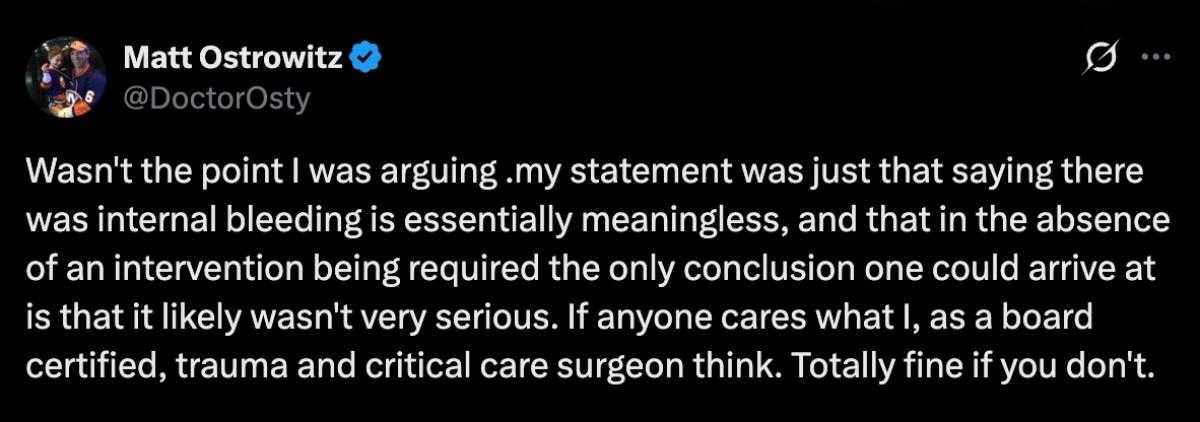
"Internal bleeding is not a real medical term so [it] could refer to anything from an abdominal wall bruise to massive hemorrhage from a splenic or hepatic laceration," wrote Dr. Ostrowitz. "If it didn't require surgery (or some type of interventional radiological procedure) then it wasn't very significant," he added.
There have been a lot of posts on social media suggesting that "internal bleeding" could also refer to bruising. Another X user replied to Dr. Ostrowitz, asking if Ross could merely have a bruise. "Maybe, said Dr. Ostrowitz, "I have no idea." He continued, "Just saying that 'internal bleeding' is not a term doctors use, precisely because it is vague and non-specific."
Dr. Ostrowitz proceeded to give several examples of medical terms that more accurately describe internal bleeding. "If somebody has a bleeding ulcer or bleeding from a diverticulum in their colon, we'd use terms like hematemesis or hematochezia, or just 'GI hemorrhage,'" he explained. "If there is bleeding inside the abdominal cavity, that's Hemoperitoneum," and so on. "Internal bleeding encompasses all of them so it is a very little utility. Hence why it's a term never used by physicians."