
"No Work No School No Shopping" — Details on Its Meaning and How It Connects to a Planned General Strike
A simple phrase has sparked nationwide attention. Here’s what it means, where it comes from, and how it’s being used.
Published Jan. 30 2026, 10:05 a.m. ET

The phrase “No work, no school, no shopping” has circulated widely during moments of coordinated protest, often appearing across social media, flyers, and online discussions. Its blunt wording has raised questions about what it actually calls for and whether it signals a strike, a boycott, or something else entirely.
While the message is short, its meaning is tied to a broader protest strategy that relies on collective participation rather than formal demonstrations.
The phrase is commonly associated with actions described as a National Shutdown, where supporters are encouraged to pause everyday activities for a defined period.
Understanding what “no work, no school, no shopping” means helps clarify why the message is used and how it fits into larger conversations about protest, labor, and economic pressure.
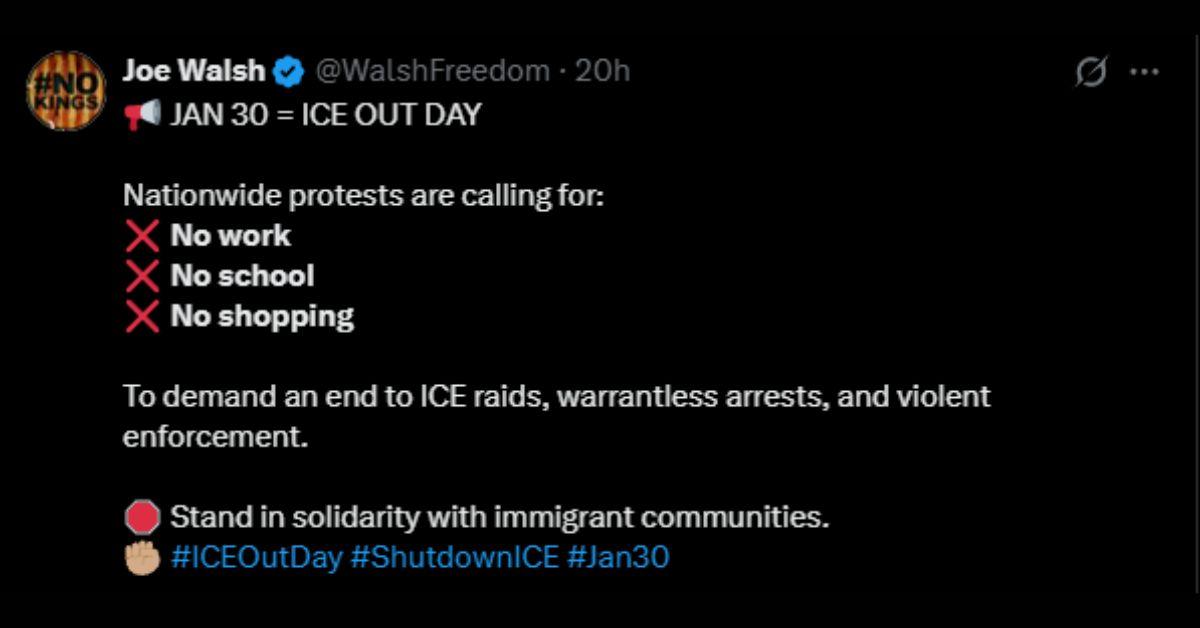
"No work no school no shopping" means a voluntary pause in daily participation.
“No work, no school, no shopping” is a slogan used to describe a form of protest based on absence rather than physical gathering. According to the National Shutdown campaign, the phrase encourages people to voluntarily refrain from working, attending school, and spending money as a way to signal opposition to specific government policies. Participation is not enforced and depends entirely on individual circumstances.
Rather than organizing marches or centralized events, the approach focuses on stepping back from routine systems that rely on daily involvement. Supporters believe that when enough people pause their participation at the same time, the impact becomes noticeable through reduced activity rather than visible demonstrations.
The slogan often appears alongside messages opposing funding for U.S. Immigration and Customs Enforcement (ICE). Organizers frame the pause as a symbolic act meant to draw attention to immigration enforcement practices without direct confrontation.
The phrase is often linked to calls for a general strike.
Actions using the “no work, no school, no shopping” message are frequently described as a general strike. In this context, the term refers to a broad withdrawal from labor, education, and consumer spending across multiple sectors rather than a work stoppage tied to a single employer or union.
The emphasis is on collective visibility rather than formal structure. By encouraging people from different roles to participate in parallel ways, organizers aim to demonstrate how interconnected daily systems are and how dependent they are on routine engagement.
Here's how national shutdown actions are organized.
National shutdown efforts are primarily organized through independent websites, social media platforms, and community networks. Campaign materials typically outline a date, a slogan, and the general idea of pausing activity, but provide few specific instructions beyond that.
There is no requirement to register, attend events, or report participation. Some people choose to take time off work if possible. Others avoid shopping, delay purchases, or keep children home from school where feasible. The campaign’s messaging emphasizes voluntary action rather than obligation.
News coverage of similar actions has noted that their impact is often difficult to measure, since success is not defined by attendance but by overall awareness and disruption of normal patterns.
At its core, “no work, no school, no shopping” represents a long-standing protest method centered on economic and institutional withdrawal. Similar strategies have been used historically to draw attention to labor conditions, government policies, and social issues.
Whether or not individuals choose to participate, the phrase itself has become a shorthand for a type of protest that relies on collective absence rather than physical presence. Its continued use reflects broader discussions about how modern movements organize, communicate, and attempt to create impact without centralized leadership.