
A Red Card Can Have Major Consequences at the 2026 FIFA World Cup
A red card doesn't just affect the current match — it can also impact the next one.

Published June 12 2026, 12:57 p.m. ET

The 2026 FIFA World Cup has already produced plenty of drama, including several players being sent off during the tournament's opening matches. As fans watch teams battle through the group stage, some viewers are wondering exactly what happens when a player receives a red card.
A sending-off can change the outcome of a game in an instant, but the consequences don't end when the final whistle blows. FIFA's disciplinary rules also determine whether players can participate in future matches.
Here's what happens if a player receives a red card during the World Cup.
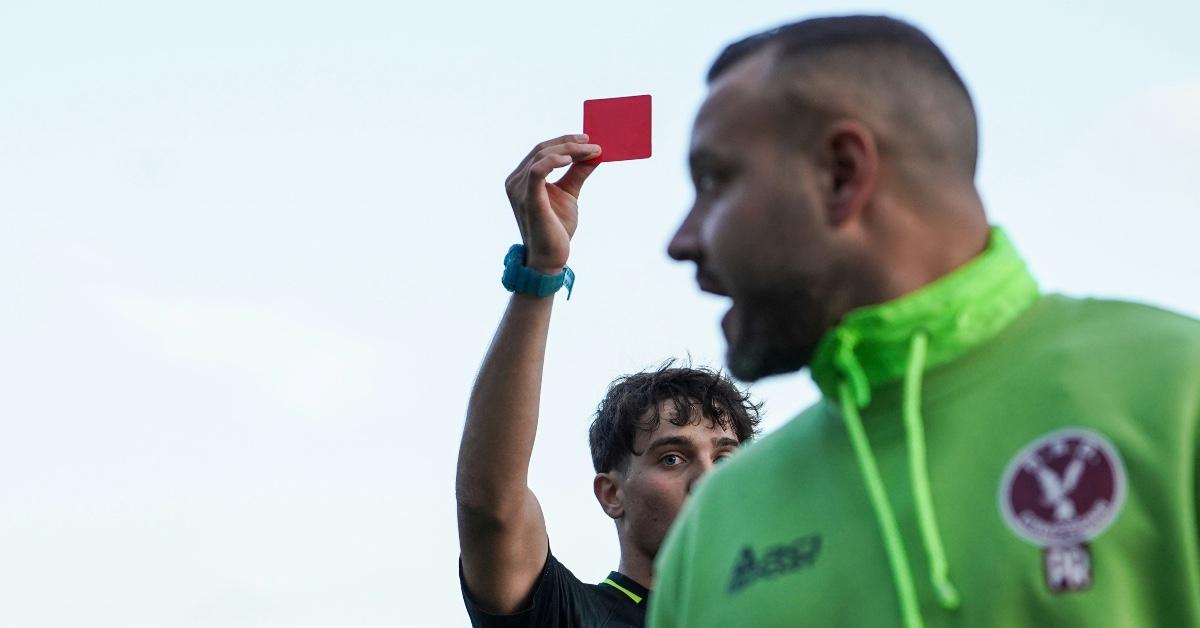
What happens if you get a red card in the World Cup?
A player who receives a red card during a World Cup match is immediately removed from the game and cannot be replaced. That means their team must continue playing with 10 players for the remainder of the match.
In addition to being sent off, the player automatically receives a one-match suspension. According to FIFA's World Cup disciplinary rules, this applies whether the player receives a straight red card for a serious offense or is sent off after receiving two yellow cards in the same match.
FIFA can also impose harsher penalties in certain circumstances. As the BBC reported, the governing body retains the right to impose "further sanctions" if it determines that an incident warrants additional disciplinary action.
The opening game of the 2026 World Cup provided several examples of how the rule works in practice.
South Africa's Yaya Sithole and Themba Zwane were both shown red cards and will miss their team's next match against the Czech Republic.
Mexico defender Cesar Montes was also sent off and is suspended for Mexico's upcoming game against South Korea.
How do yellow card suspensions work at the World Cup?
Players can also be suspended without receiving a direct red card. A player who accumulates two yellow cards before FIFA's designated reset points will receive a one-match suspension. However, FIFA introduced changes for the expanded 48-team tournament to reduce the chances of players missing major matches because of accumulated cautions.
Yellow cards are wiped clean after the group stage and again after the quarterfinals. As a result, players who advance deep into the tournament won't carry yellow-card warnings all the way through the knockout rounds. A second yellow card during the same match remains more severe.
When a player receives two yellow cards in one game, the second caution automatically becomes a red card, resulting in an immediate ejection and a suspension for the next match.
FIFA also allows video review through VAR in certain situations. Officials can review potential red-card incidents and, beginning with the 2026 tournament, VAR may also intervene when a player is incorrectly sent off for a second yellow card. While yellow-card warnings from qualifying do not carry over into the World Cup, certain red-card suspensions from qualifying competitions can follow players into the tournament if the offense was considered serious enough.