
The Meaning of Dry Begging and the Subtle Way It Shows up in Toxic Relationships
They’re not asking for anything ... but they are. Dry begging is the red flag no one sees coming.
Updated Jan. 16 2026, 2:57 p.m. ET

If you've spent any time on TikTok, chances are you’ve seen the term “dry begging” tossed around in conversations. It's one of those phrases that seems funny on the surface — until you realize it might be describing something you've seen (or done) more often than you'd like to admit.
Dry begging is about hinting at needs, wants, or insecurities in a way that puts pressure on others without actually asking for anything. In the wrong context, dry begging can look like manipulation.
What makes dry begging such a slippery slope is that it often feels harmless at first. For example, someone posts about stressful bills or feeling lonely without explicitly asking for help. The goal of these posts, however, is to get someone on the other end to offer something.
As Verywell Mind puts it, “It’s a form of indirect communication that seeks validation or assistance, often without accountability.” It’s an emotionally loaded and passive behavior that can be incredibly difficult to deal with.

The meaning of dry begging depends on context, but it always involves an unspoken ask.
At its core, dry begging is about saying just enough to make someone feel obligated to respond. Think of it like emotional fishing. You're not saying, “Can you cover this bill for me?” but rather, “Ugh, my rent is due, and I just got hit with an overdraft fee.” If the other person doesn’t take the bait, they might even feel guilty for not doing so. Unfortunately, this dynamic gets messy and toxic fast.
Parade describes dry begging as a behavior that walks the line between oversharing and expectation. It can be defined as someone who shares a problem they have in a way that implies they need help without actually asking for the help. In relationships, this can create an imbalance where one person constantly hints, and the other feels emotionally responsible without clear consent.
Over time, that kind of pattern can wear down trust. When someone regularly uses dry begging instead of direct communication, it signals they’re uncomfortable expressing needs — and instead rely on guilt or implication. That’s why mental health professionals often link dry begging to poor emotional boundaries or even codependent tendencies.
It’s important to recognize when dry begging becomes a red flag in dating and relationships.
Not all dry begging is manipulative. Sometimes people don’t even realize they’re doing it. When it becomes a pattern, especially in romantic relationships, it’s often a sign of deeper issues — like fear of rejection, emotional immaturity, or an avoidant attachment style. Instead of being open about needs, someone might resort to these subtle, guilt-tinged cues to get what they want.
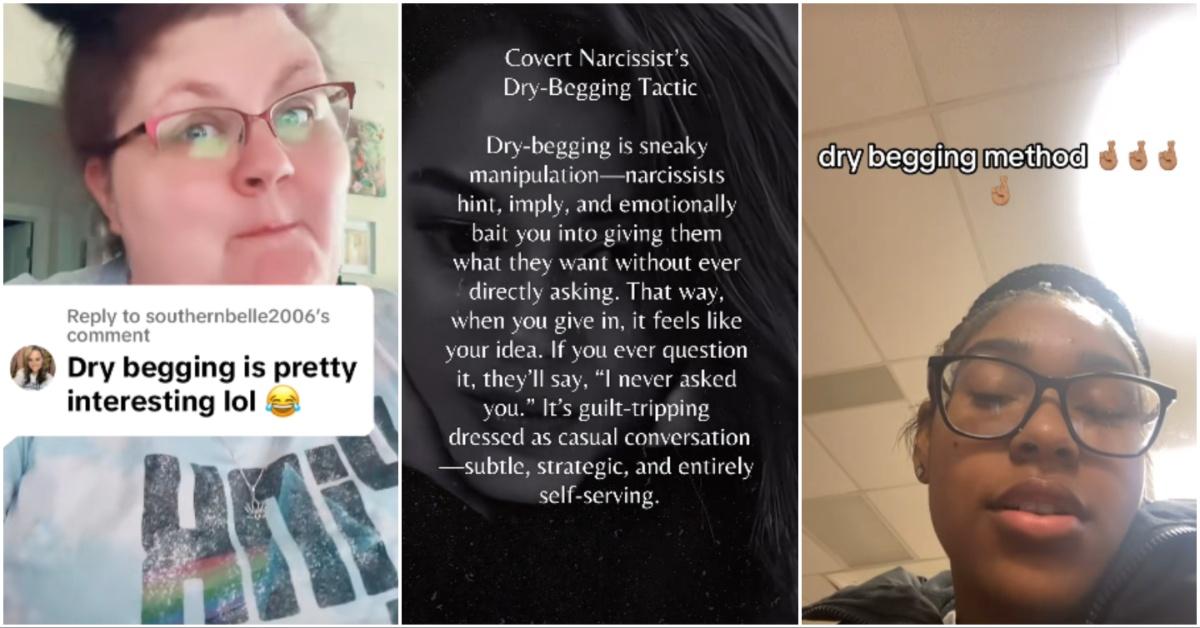
What makes this especially toxic is that the other person rarely feels they can respond honestly. If you say no, you might seem cold. If you don’t acknowledge the hint, you seem oblivious. Finally, if you do respond with help or support, you may later feel resentful because you were never asked directly.
That’s why identifying the reasoning for the dry begging in your own relationships can be such a game-changer. It’s not about judging others, but about recognizing when communication starts to feel one-sided, vague, or emotionally loaded. Direct conversation might not always be easy, but it’s a whole lot healthier than hoping someone else reads between the lines.
So, if you find yourself on the receiving end of repeated “subtle” complaints, vague posts, or passive hints that clearly want a response — pay attention. Furthermore, if you are the one dry begging it might be time to practice just saying what you mean.