
You Can't Just Pick up a Case of Greenland at the Store, so How Did Denmark Acquire It?
"If we have to choose between the United States and Denmark here and now, we choose Denmark."

Published Jan. 21 2026, 12:29 p.m. ET

If you asked most Americans what they thought about Greenland before 2025, they might not have much to say. Because a portion of President Donald Trump's second term has been devoted to acquiring Greenland, either financially or by military force, the country hears about the frigid territory all the time. In fact, there is an entire Wikipedia page devoted to a proposed acquisition of Greenland by the United States.
Shockingly, this is not a new idea. It was first floated back in 1867 by Secretary of State William H. Seward, who argued it would "ensure U.S. economic dominance," per the American Social History Project. Fast forward nearly 160 years, and Trump claims that acquiring Greenland would help keep the United States safe from Russia and China. For now, Greenland is part of the Kingdom of Denmark, which officially locked it down in 1916. Here's how.
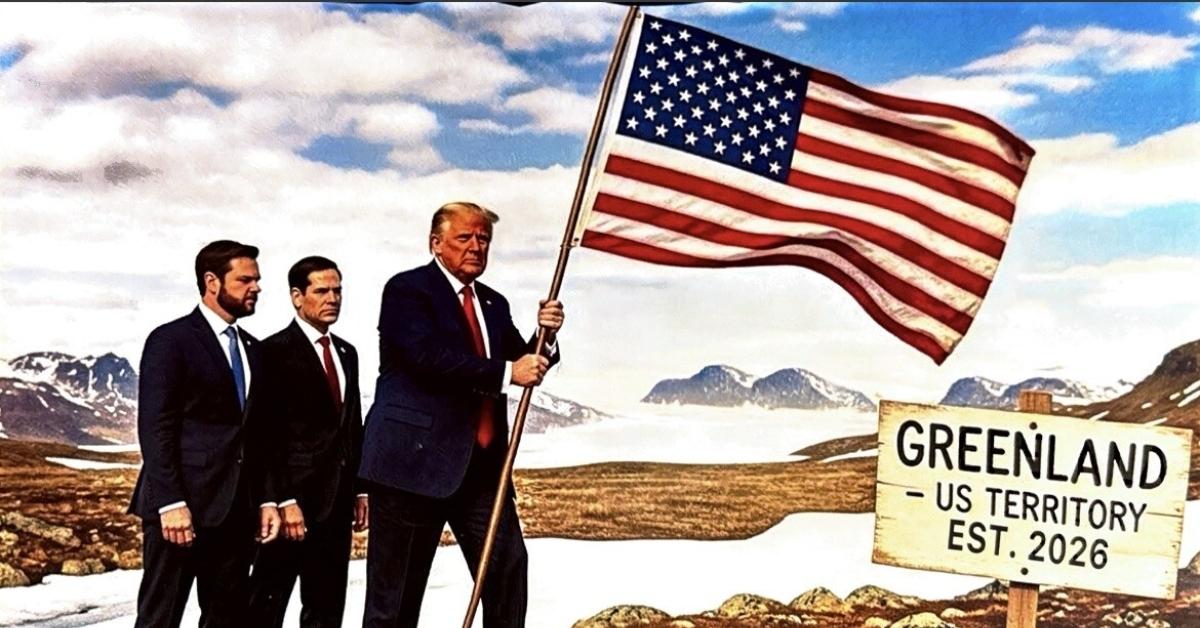
Denmark got Greenland courtesy of the United States.
For this answer, we are heading straight to the source. According to the Danish Institute for International Studies, Greenland was initially colonized by Vikings. When the Norse Viking Erik the Red was kicked out of Iceland for murder, he made his way to what is now called Greenland near the end of the 10th century.
Although it is quite cold there for longer periods than most places in the world, Erik was savvy. Rumor has it that he named the new area Greenland in order to tempt others to join him on his banished journey. The Norse people stayed in Greenland for centuries until the start of the 15th century, when they suddenly vanished.
A few hundred years later, in 1721, a Norwegian priest and missionary showed up to reconnect with Greenland. Hans Egede's mission was funded by the Dano-Norwegian crown, and his goal was to convert the Inuit people living there to Christianity. This was the beginning of their colonial period, which ended when Denmark and Norway broke up in 1814. A century later, the United States purchased the Danish West Indies and, in doing so, confirmed Denmark’s rights to Greenland. This was in 1916.
Greenland was officially decolonized in 1953.
Things were still a bit unsteady for Greenland until the United Nations stepped in and forced it to decolonize in 1953. As such, it was incorporated into Denmark and given two seats in the Danish Parliament. In 1979, Greenland got its own parliament. Three decades later, a law was passed that gave Greenlanders an option to vote on whether or not they wanted to be independent from Denmark. They have yet to make any changes.
According to a poll conducted by the independent research firm Verian Group, 85 percent of Greenlanders do not want to leave the Kingdom of Denmark for the United States. In January 2026, Greenland Prime Minister Jens-Frederik Nielsen said in a press conference that, "If we have to choose between the United States and Denmark here and now, we choose Denmark," per ABC News.