
Why Are Argentina's and Uruguay's Flags So Similar? Here's What We Know
Both countries have flags featuring a sun.
Published April 9 2026, 1:16 p.m. ET

If you've ever wondered why the countries of Argentina and Uruguay share similar flags, you aren't alone. Both countries have flags that feature the Sun of May, and both flags are yellow, white, and blue.
The Sun of May in Spanish means Sol de Mayo, and it is the national symbol of the Río de la Plata countries — Argentina and Uruguay, per Britannica. The flag of Argentina is also known as the Argentine flag, while the flag of Uruguay is also known as the National Pavilion.
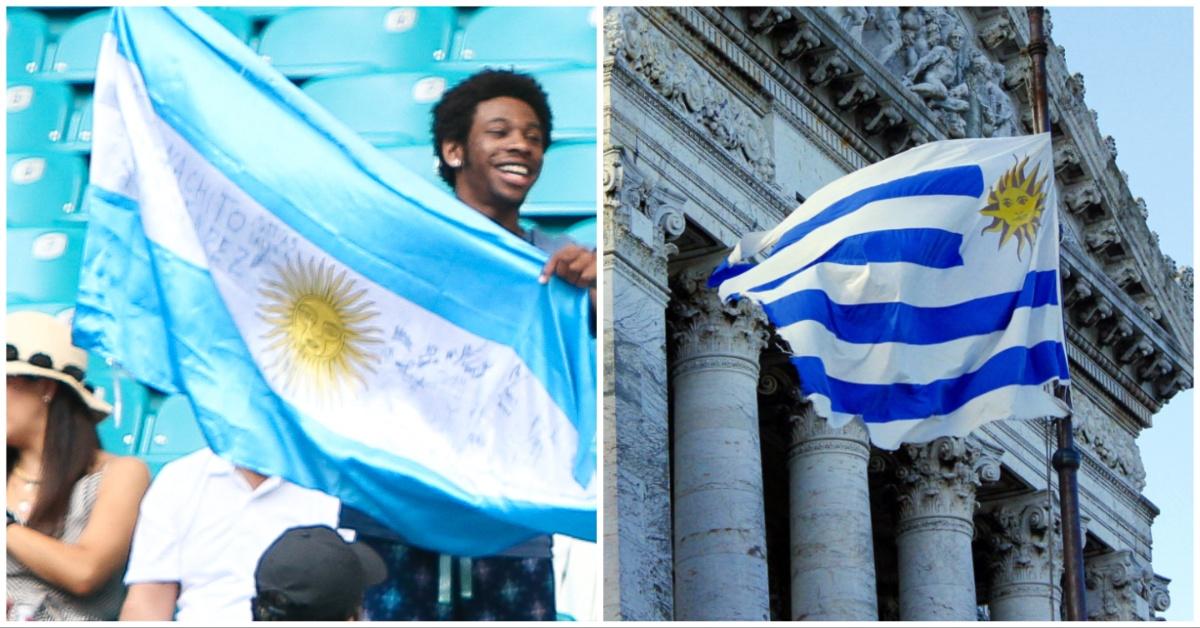
Why are Argentina's and Uruguay's flags so similar?
The Argentine flag and the National Pavilion both feature the Sun of May, which is considered a symbol that represents the May Revolution of 1810. The May Revolution marked the beginning of independence from the Spanish Empire for the region.
The Sun of May is also a symbol that represents Inti, the Incan sun god.
Argentina and Uruguay were both part of the Viceroyalty of the Río de la Plata (viceroyalty of the Spanish Empire). Uruguay was originally the eastern province (Banda Oriental) of the United Provinces of the Río de la Plata.
The blue and white colors on each flag are connected to the House of Bourbon dynasty of France, and they were used in the country's flags to represent the identity of creole revolutionaries who broke away from the Spanish Empire.
According to Gettysburg Flag Works, the blue and white stripes on the Argentine flag represent the sky and clouds, and historians believe that a deeper meaning of the colors actually represents the loyalty Argentine leaders had toward the House of Bourbon. An Argentinian general, Manuel Belgrano, designed the flag as a military banner, and the Sun of May was added by the government several years later.
The Republic of Uruguay officially gained a national flag in 1828. The flag was designed by Joaquín Suárez, and it was based on the American flag. The white background had nine blue horizontal stripes that represented the nine original departments of Uruguay, and the Sun of May was added to the white portion of the flag. The number of blue stripes was later reduced to four stripes, with the white and blue stripes representing the nine departments, and this is how the flag remains to this day.
Uruguay also has two other flags — the Artigas flag and the Flag of the Treinta y Tres. They were created during the liberation wars against Brazil and Spain during the 19th century and made official in 1952. Both flags feature a red, white, and blue stripe.